
Reviewed · TUK-TUKS
Madrid Historical Tour with Local Guide in Eco Tuk Tuk Private
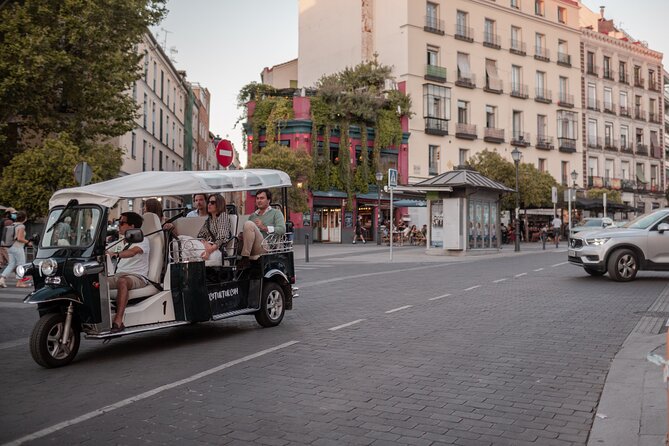
Electric tuk-tuks make Madrid click fast. This private ride lets you cover big sights without the slog, and you still get real story time from a local guide at classic landmarks like San Francisco el Grande and the Royal Palace area, plus a few photo stops built for the best angles.
I especially love the private setup, because it feels like you are traveling with your own Madrid expert instead of juggling with a big group. I also like the electric tuk-tuk plus the winter blankets, since Madrid weather can swing and the ride stays comfortable and practical, whether it is cool mornings or hot afternoons.
One thing to consider: your route and photo stops are fixed, and if you arrive more than 15 minutes late, the tour can get shortened with no refund. Also, the meeting point is in an underground transit area near the Royal Palace, so follow the instructions carefully.
In This Review
- Key highlights at a glance
- Value and pace: what $28.66 buys you in Madrid
- Riding the electric tuk-tuk without the usual tour fatigue
- The route in real order: market tastes, San Francisco el Grande, and Atocha
- Covered market atmosphere from the early 1900s
- San Francisco el Grande: dome drama in the Palacio neighborhood
- Atocha Station, Madrid’s busiest heartbeat
- Parliament and royal power: Spanish Courts, Cibeles, and the Prado zone
- The Palace of the Spanish Courts: lions, steps, and iron-cast symbolism
- Plaza del Dios del Mar and Cibeles: football geography in marble form
- The Prado area and San Jerónimo el Real
- Puerta de Alcalá, Bank of Spain, and Plaza de Santa Ana street life
- Puerta de Alcalá built by Carlos III
- Civic palaces around the gate: Buenavista, Linares, and Communications
- The Bank of Spain headquarters: the ornate argument
- Plaza de Santa Ana: a classic open space with constant change
- Almudena Cathedral, Palacio de Oriente, and royal gardens
- Almudena Cathedral and the museum story rooms
- Palacio de Oriente: royal residences and garden boundaries
- Temple of Debod: the ancient break that feels surprising
- Should you book this eco tuk-tuk historical tour?
- FAQ
- How long is the Madrid Historical Tour in the eco tuk-tuk?
- Is this tour private?
- What language is the tour offered in?
- Is the tuk-tuk electric?
- Are blankets provided for cold weather?
- What stops do you visit?
- Is Temple of Debod admission free on this tour?
- Where do you meet the tour?
- Are pets allowed on the tour?
- Can I cancel for free?
Key highlights at a glance
- Private ride for your group (no sharing your commentary with strangers)
- 100% electric, sustainable tuk-tuk that is easy to board and ride
- Blankets provided for winter and protective layers for wind and rain
- Photo stops planned in advance, so you are not wasting time guessing locations
- English-speaking local guides with a track record for clear explanations and humor
- Family-friendly pace, with minimal walking and built-in breaks for comfort
Value and pace: what $28.66 buys you in Madrid
At about $28.66 per person, this tour is priced like a smart orientation plan, not a long, exhausting day of sight-by-sight walking. You are paying for three things: a vehicle (and driver), a local guide who sets context, and a route that strings together major “I have to see that” Madrid spots.
The big value is pace. Madrid looks compact on a map, but stops add up fast on foot. Here, you get to move between neighborhoods quickly, yet still stop at iconic places often tied together by geography and by theme, like churches, royal power, and big civic squares.
Duration runs roughly 1 to 4 hours, so you can match it to your schedule. If you have only one day, an earlier, shorter version helps you build a mental map and a list for what to return to later.
Other days out near Madrid
- Madrid Essential: Historic Center, Plaza Mayor & Royal Palace
★ 5.0 · 6,416 reviews - Madrid Tapas & Taverns Small Group Food & History Tour
★ 5.0 · 2,664 reviews - Madrid Historic Centre Food Tour with Authentic Tapas & Wines
★ 5.0 · 814 reviews
Riding the electric tuk-tuk without the usual tour fatigue
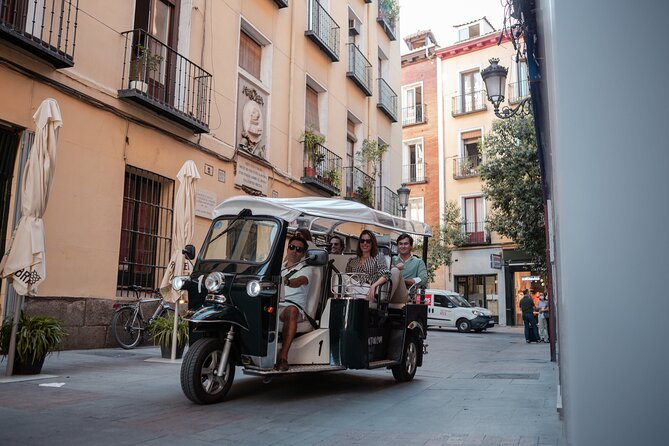
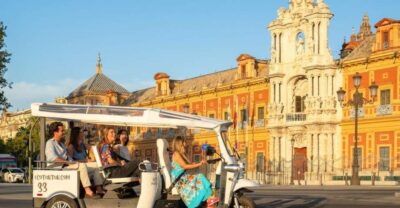
The tuk-tuk experience is the point. It is fun, and it also works because it is open and easy to view through while you are rolling past viewpoints around the historic center. And since it is 100% electric, it feels cleaner and quieter than many older sightseeing vehicles.
The comfort details matter more than you might think. Winter touring comes with blankets and protective layers for wind and rain, so you are less likely to cut the tour short because you got cold. If you are traveling with older people, the drivers assist with getting on, which is a real practical benefit when you want to see a lot without big stairs or slippery transfers.
One practical drawback to keep in mind: it is still a moving vehicle, so sound quality can be inconsistent. One review noted the sound system was not great, so if you are someone who needs crisp audio for every sentence, you may want to sit closer and keep your eyes on the guide when they speak.
The route in real order: market tastes, San Francisco el Grande, and Atocha
A good way to understand this tour is as a sweep through four different Madrid moods. First comes food and everyday life, then faith and architecture, then a transport hub that shows how the city breathes, and then the civic and royal centers.
Covered market atmosphere from the early 1900s
You start with a covered market area dating to around 1916, where local food, delicatessen stalls, and events sit in an elegant indoor setting. Even if you do not plan a full meal, this stop gives you a feel for Madrid beyond monuments. It is also a nice reset after arriving, because markets are less formal and more sensory than churches and palaces.
The practical tip here: if you have time that day for a longer food break, you will know where to point your appetite. If not, you still get the local vibe that makes the later stops feel more grounded.
Also within reach of Madrid:
- Madrid: Tour Bernabéu Entry Ticket
★ 4.5 · 21,573 reviews - Madrid: Prado Museum Entry Ticket
★ 4.6 · 20,699 reviews - Madrid: “Emociones” Live Flamenco Performance
★ 4.8 · 12,866 reviews - Madrid: Panoramic Route City Tour
★ 4.1 · 12,259 reviews
San Francisco el Grande: dome drama in the Palacio neighborhood
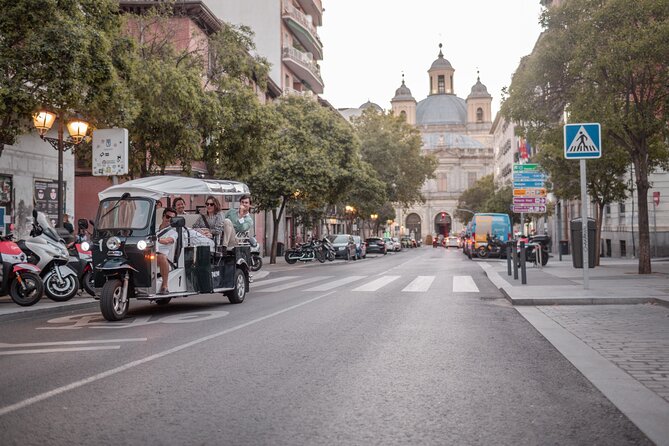
Next is the Royal Basilica of San Francisco el Grande, officially the Basilica of Our Lady of the Angels, located in the Palacio neighborhood. This is one of those Madrid churches you remember because of the sheer impact of the space and the scale.
From a storytelling standpoint, this stop helps you understand Madrid as a city built on layers. You are seeing how religious architecture shapes neighborhoods and how big institutions sit inside the historic center, close enough to other major landmarks that you can connect the dots quickly on a short trip.
Atocha Station, Madrid’s busiest heartbeat
Then you roll to Atocha station, a major railway complex near Plaza del Emperador Carlos V. It is described as the busiest station in Spain and one of the key hubs in Europe, and that matters because it shows the city’s rhythm.
Atocha is not just “a train station.” It is the place where visitors arrive, locals connect, and long-distance travel converges. Even if you are not taking a train, seeing it on your first day helps you understand why Madrid feels like it is always moving.
Parliament and royal power: Spanish Courts, Cibeles, and the Prado zone
Now the tour turns more formal. This is where the architecture gets theatrical and the streets start to feel like government corridors.
The Palace of the Spanish Courts: lions, steps, and iron-cast symbolism
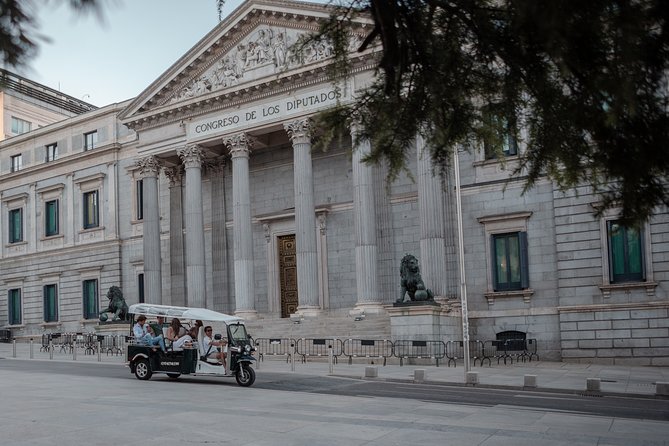
One of the most vivid stops is the Palace of the Spanish Courts, built on the site of an old convent that later housed Congress between 1834 and 1841. The exterior details are not just decoration. They connect history, politics, and symbolism in stone and metal.
Look for the neoclassical portico with six imposing striated columns of the Corinthian order, and the triangular pediment topped with reliefs by Ponciano Ponzano. The emblematic lions flanking the entrance are described as being cast using iron from cannons captured during the war in Africa. That is a wild detail, and it is the kind of specific story that makes the building feel real instead of just “pretty.”
Inside, there is mention of the well-known Session room, plus the library or Conference room known as the lost steps room. Also note that the bronze door opens only on very marked occasions, so it is more about exterior impressions and architectural context than expecting a casual peek inside.
Plaza del Dios del Mar and Cibeles: football geography in marble form
The tour also swings through the fan culture side of Madrid by connecting Atlético de Madrid celebrations at the Plaza del Dios del Mar with Real Madrid celebrations at Cibeles. Even if you do not care about match days, this is a useful way to read the city. Squares become identities. Streets become teams.
If you are going to any games or planning a stadium-related day, this stop gives you landmarks to anchor your route. And if you just want a photo with energy around you, these are the kinds of plazas where that works.
The Prado area and San Jerónimo el Real
The tour then references the Prado area as a major art anchor, described as one of the world’s most important museums for European painting. You also get a nearby church stop: San Jerónimo el Real, popularly known as Los Jerónimos, a late Gothic parish church with Renaissance influences from the early 16th century.
What makes this work as a tour stop is contrast. After the political seriousness of the Spanish Courts and the sport-filled squares, you get a church that shows architectural “style mixing” over time. The material also notes that little remains of the original building because it was remodeled and restored repeatedly, which is a helpful reminder that Madrid’s landmarks are not frozen snapshots.
Puerta de Alcalá, Bank of Spain, and Plaza de Santa Ana street life
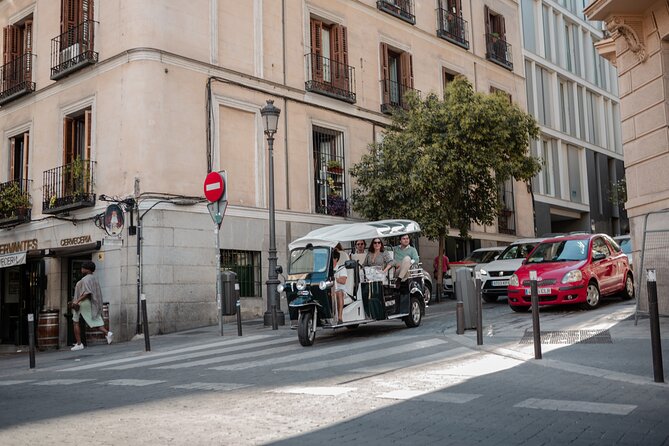
This segment is about Madrid as a ceremonial capital, plus a dose of everyday street atmosphere.
Puerta de Alcalá built by Carlos III
You visit the monumental gate built by order of Carlos III to replace an older 16th-century gate, inaugurated in 1778. It is one of those landmarks that reads instantly in photos because it is bold and symmetrical. But the best part is understanding why it exists, and how it signals Madrid’s shift toward grand, planned city imagery.
Civic palaces around the gate: Buenavista, Linares, and Communications
The tour also passes a lineup of important buildings around the area, including Buenavista Palace (Army Headquarters), Linares Palace (America House), and the Communications Palace, described as formerly the Post Office and now the Madrid City Council. The Bank of Spain is also mentioned in this surrounding context.
This is a useful “map lesson.” You start to see that what looks like separate landmarks are actually part of one institutional zone, all tied to state power, administration, and national finance.
The Bank of Spain headquarters: the ornate argument
You also get a specific description of a highly decorative bank building that was awarded at the National Exhibition of Fine Arts in 1884. It was built so the National Bank would have a headquarters matching the importance of its functions, like the single issue of coins and bills across Spain.
Even if you think it is too decorative, that phrase about decorative mismatch is exactly the kind of candid observation that helps you see the city with your own eyes instead of with just postcard approval.
Plaza de Santa Ana: a classic open space with constant change
Finally in this stretch, the tour stops at Plaza de Santa Ana, an open space in the Cortes neighborhood dating from 1810. The note here is that the square has gone through multiple urbanization processes over time, with varying degrees of success.
That is practical context for what you will feel while walking there. This plaza is not fixed and untouched. It is a living public space that has been reshaped as Madrid grew and changed.
Almudena Cathedral, Palacio de Oriente, and royal gardens
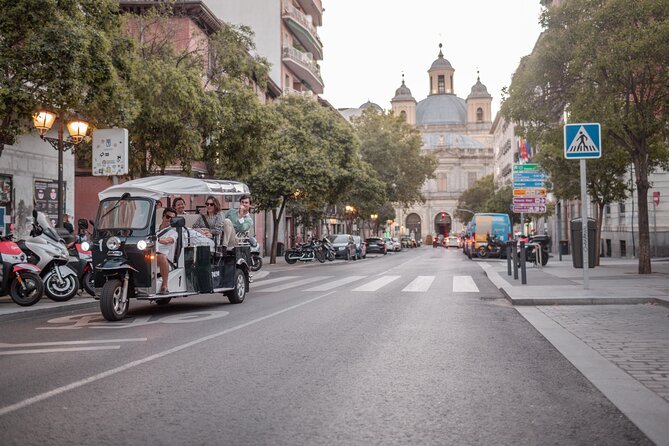
This is where the tour leans into Madrid’s grandest ceremonial side. You get religion, museum context, and royal architecture all in one arc.
Almudena Cathedral and the museum story rooms
The Almudena Cathedral is presented as Madrid’s most important religious building. It was consecrated on June 15, 1993, by Pope John Paul II, and is noted as the first consecrated cathedral outside Rome.
You also have the Almudena Cathedral Museum, described as gathering dozens of objects telling the story of the diocese of Madrid. The museum has twelve rooms with items ranging from mosaics to episcopal shields and ornament.
If you like learning how churches operate beyond the main service, this museum angle helps. Even if you are short on time, the idea is that Madrid’s cathedral is not only a view, it is also a narrative hub.
Palacio de Oriente: royal residences and garden boundaries
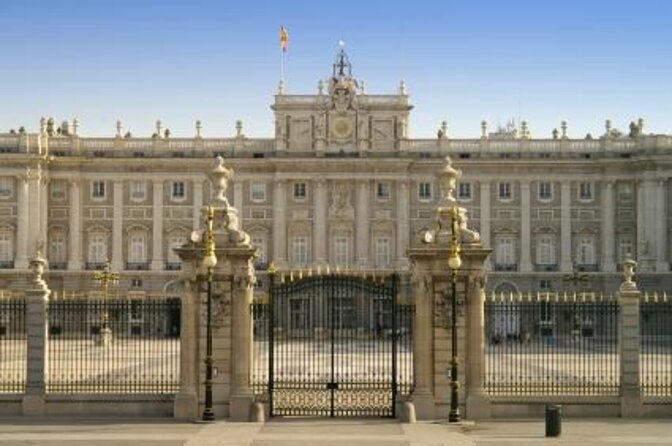
Then you go to the Royal Palace, also called Palacio de Oriente. Construction began in 1738 and lasted 17 years, with Carlos III establishing habitual residence there in 1764. The palace sits on the location of the older Palace of the Austrias, destroyed by fire on Christmas Eve 1734.
You also get garden context around the palace: Campo del Moro gardens to the west, and Sabatini gardens to the north. Campo del Moro is described as dating back to the Middle Ages, while Sabatini gardens were created in the twentieth century. The note that Campo del Moro can be visited during the day helps you plan if you want to follow up on your own.
One practical advantage: palace-and-garden areas can be spread out and confusing. Seeing them in a guided sequence makes it easier to pick where you want to spend more time later.
Temple of Debod: the ancient break that feels surprising
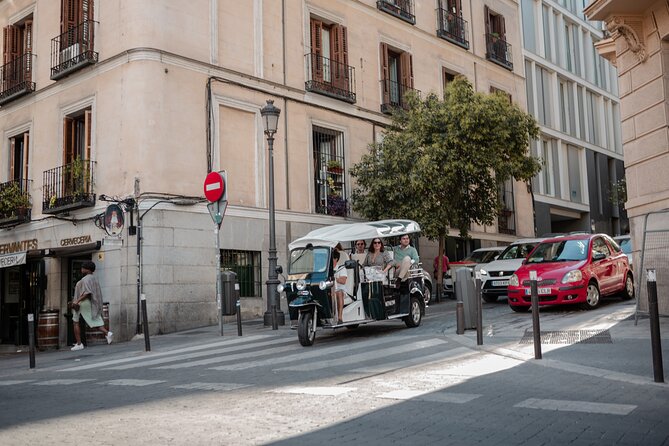
The tour ends (or includes) Temple of Debod, an ancient Egyptian building located in Madrid west of Plaza de España. It sits near Paseo del Pintor Rosales on a hill, and it is described as being on the site of the Cuartel de la Montaña.
The best part is that this stop is not “Madrid only.” It gives you a global jolt. It also has a practical timing note, around 10 minutes, and admission is listed as free.
Even if you are not an Egypt buff, it works because it changes the mood. After palaces and cathedrals, you suddenly see a different civilization style, in a city that normally feels very Spanish at street level.
Should you book this eco tuk-tuk historical tour?
I think you should book it if you want a low-stress first look at Madrid that still includes real context. It is a strong fit for first-time visitors, families, and anyone who prefers comfort over long walking days. The high overall rating (4.9 out of 5) and the fact that 97% of travelers recommend it line up with what matters most for an orientation tour: it is fun, guided, and efficient.
Skip it if you are hoping to customize the route or linger on your own at stops. The stops and photo points are prearranged, and if your day depends on specific timing choices, that rigidity may annoy you.
If you do book, my advice is simple: schedule it early in your trip. You will leave with names, neighborhood cues, and a short list of what to revisit on foot when you have more time.
FAQ
How long is the Madrid Historical Tour in the eco tuk-tuk?
The tour runs for approximately 1 to 4 hours, depending on the option you choose.
Is this tour private?
Yes. It is private, so only your group participates.
What language is the tour offered in?
The tour is offered in English.
Is the tuk-tuk electric?
Yes. The vehicle is 100% electric and described as sustainable.
Are blankets provided for cold weather?
Yes. Blankets and protective layers are provided for winter touring and cold conditions.
What stops do you visit?
The itinerary includes stops such as a covered market area from around 1916, San Francisco el Grande, Atocha station, the Palace of the Spanish Courts, Plaza de Santa Ana, Almudena Cathedral, Palacio de Oriente, and Temple of Debod (among others described in the route).
Is Temple of Debod admission free on this tour?
Admission for Temple of Debod is listed as free, and the stop is about 10 minutes.
Where do you meet the tour?
Meeting starts at C. de Bailén, 4, Centro, 28013 Madrid. The pickup point is described as the underground bus station of Plaza de Oriente next to the Royal Palace, near the Prince’s Gate, and you are advised to look for the Eco Tuk Tuk signage.
Are pets allowed on the tour?
No. Pets are not allowed for security reasons.
Can I cancel for free?
Yes. Free cancellation is available up to 24 hours in advance for a full refund. If you cancel less than 24 hours before start time, the amount paid is not refunded.
Recently added around Madrid
- Atletico de Madrid Stadium & Interactive Museum Admission Ticket★ 4.5 · 183 reviews
- Photographic tour of Madrid with a professional photographer★ 5.0 · 104 reviews
- Royal Palace of Madrid Small Group Skip the Line Ticket★ 4.5 · 662 reviews
- Wine Tasting near Plaza Mayor in Madrid★ 5.0 · 210 reviews
- Madrid Old Town Donation-Based Walking Tour★ 5.0 · 109 reviews
- Audio Guided Tour of the Bullring of Las Ventas in Madrid★ 4.5 · 290 reviews
- Prado Museum with Reina Sofia Museum Guided Tour★ 4.0 · 311 reviews
- Historic Madrid Virtual Reality Experience with an Official Guide★ 5.0 · 214 reviews
Tuk-Tuks, compared.

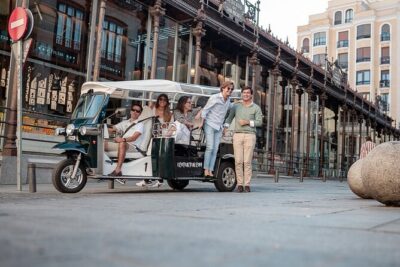
Madrid Welcome Tour with Local Guide in Eco Tuk Tuk Private
Read our review →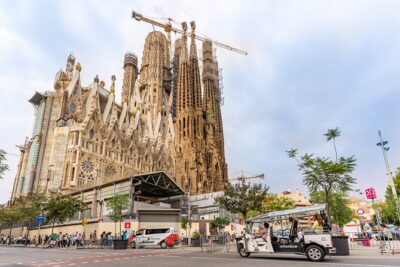
Tour Welcome Barcelona with Local Guide in Eco Tuk Tuk Private
Read our review →
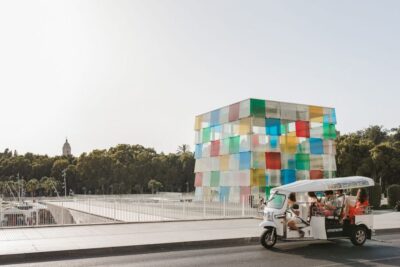


Madrid Express Tour with Local Guide in Eco Tuk Tuk Private
Read our review →Browse the lists this tour appears in